In materials R&D, quality inspection, failure analysis and other fields, DSC (Differential Scanning Calorimeter) is hailed as the “leader in thermal analysis”.
But do you really understand it?
What exactly does DSC measure?
How does it reveal a material’s glass transition, crystallization and melting behavior?
Why do DSC curves resemble an electrocardiogram, with peaks, valleys and slopes?
What is DSC? What does “Differential” actually compare?
DSC stands for Differential Scanning Calorimetry. Simply put, it measures the changes in heat absorption or release of a sample during heating or cooling.
What does “Differential” mean?
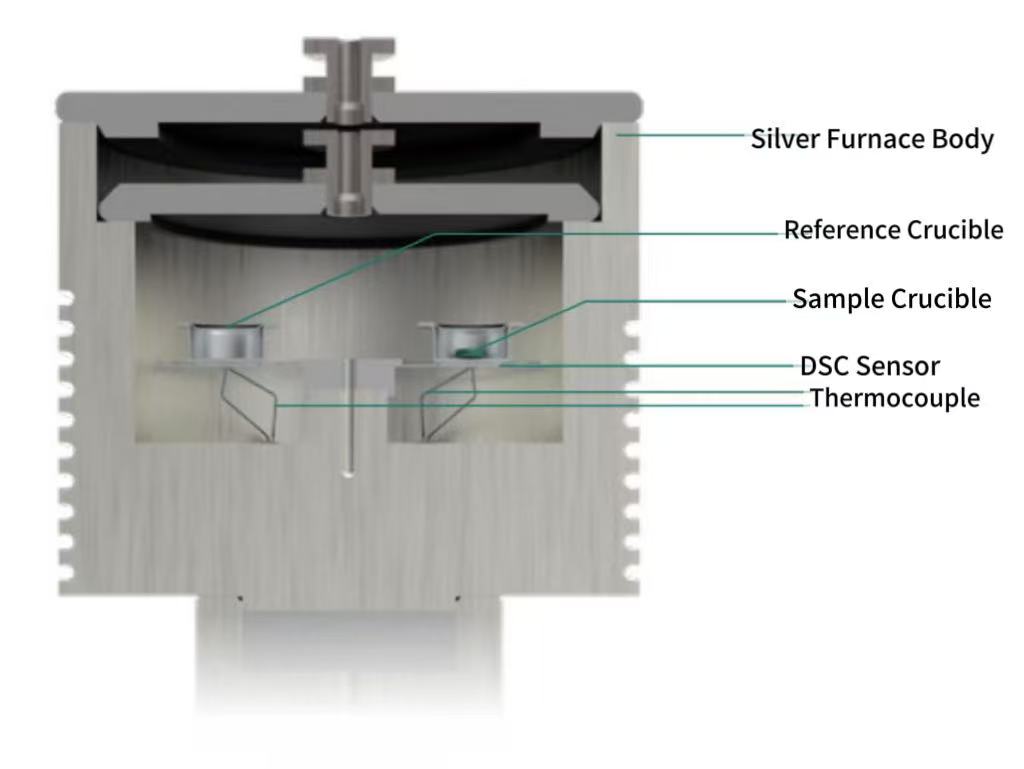
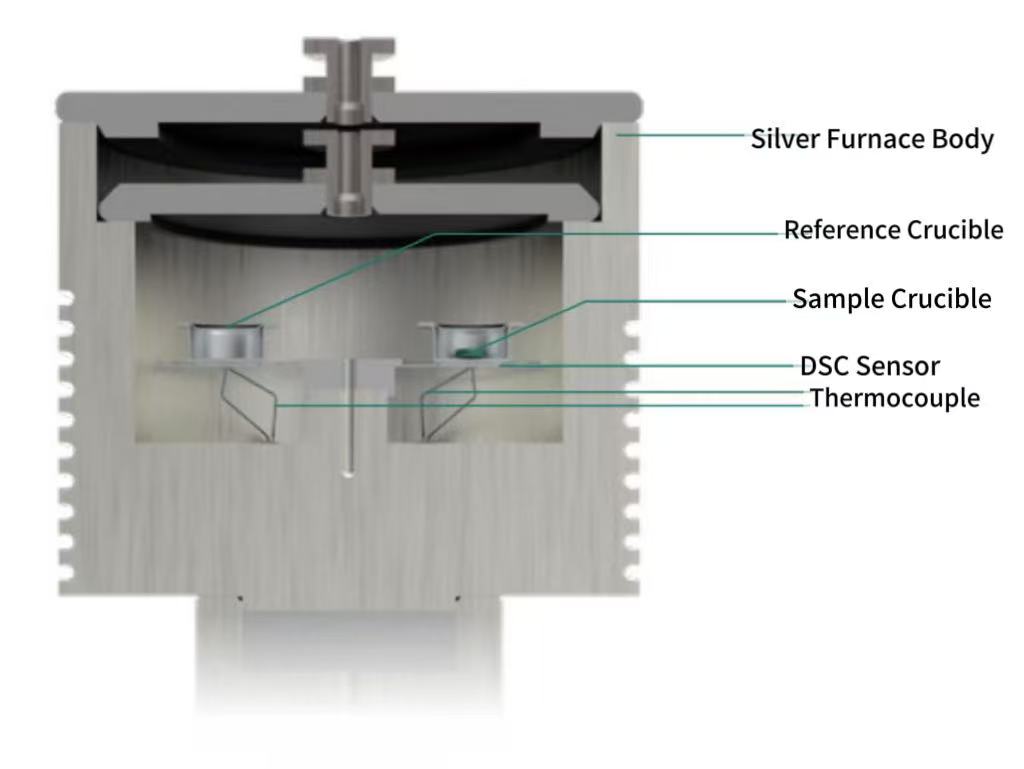
A DSC instrument has two “pans”:
- One holds the sample (e.g., plastics, pharmaceuticals, oils)
- The other holds an empty crucible (reference material)
Both pans are heated simultaneously, and the instrument continuously measures the heat flow difference between them – this is the “differential” measurement.
Example:
When the sample melts, it absorbs heat while the reference shows no change. The instrument “supplements heat” to the sample, and this compensated heat is the signal detected by DSC.
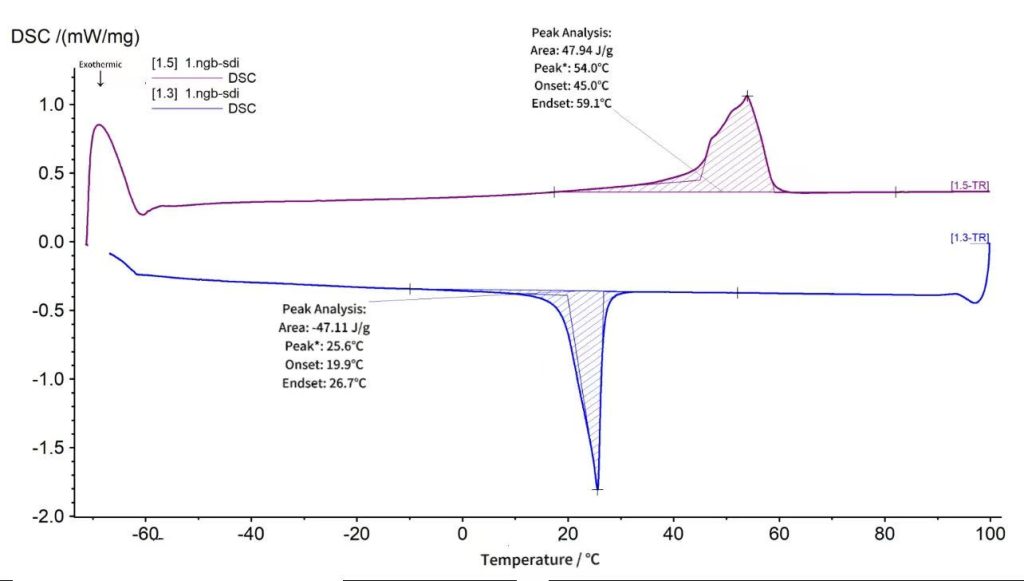
How to read a DSC curve? Understand a material’s thermal behavior at a glance
A typical DSC curve is structured as follows:
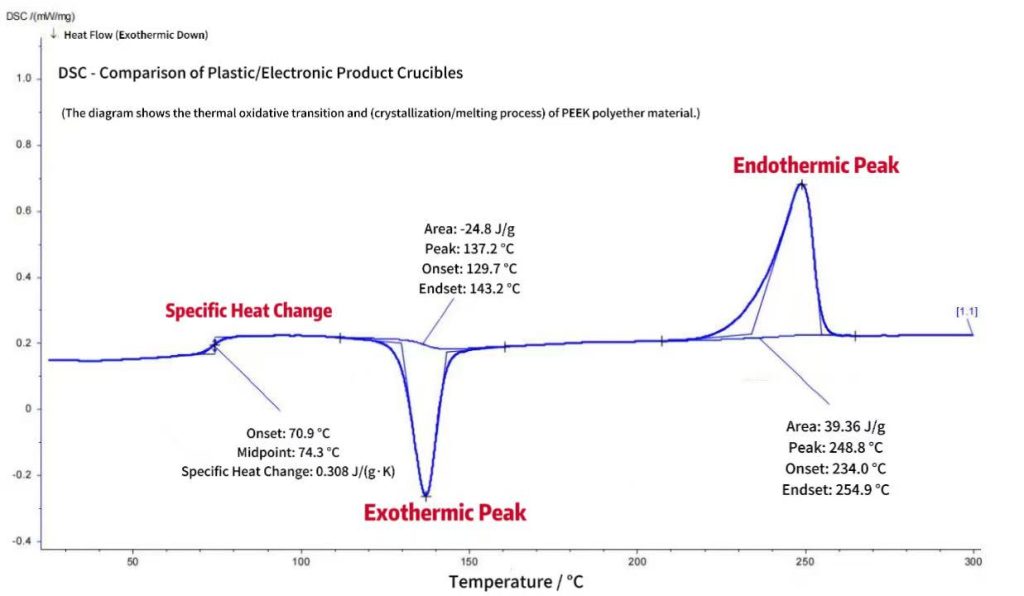
- X-axis: Temperature (°C)
- Y-axis: Heat flow (mW) – representing the rate of heat absorption or release
- Upward peak: Endothermic (e.g., melting, glass transition)
- Downward peak: Exothermic (e.g., crystallization, curing, oxidation)
Interpretation of common thermal events:
| Thermal Event | Curve | Appearance Meaning |
| Glass Transition (Tg) | Baseline shift | Material transforms from “glassy state” to “rubbery state” |
| Cold Crystallization | Exothermic peak | Amorphous regions rearrange into crystalline structures |
| Melting (Tm) | Endothermic peak | Crystalline phase melts |
| Oxidation Induction Time (OIT) | Exothermic peak | Onset of oxidative degradation of the material |
What can DSC measure? An extremely wide range of applications
Polymer Materials
- Glass transition temperature (Tg)
- Melting point (Tm), crystallization temperature (Tc)
- Crystallinity, specific heat capacity, purity
- Curing degree, cross-linking reaction
Pharmaceuticals and Food
- Polymorphic transformation of drugs (e.g., paracetamol)
- Melting/crystallization behavior of oils and fats (e.g., rapeseed oil)
- Storage condition optimization for spices (e.g., turmeric powder)
Metals and Alloys
- Melting point consistency testing of solders
- Impurity content analysis via cooling curves
Inorganic Materials
- Specific heat capacity testing (e.g., sapphire)
- Dehydration process analysis (e.g., gypsum)
Real Case Study: Curing Behavior Analysis of Adhesives
Test Purpose:To evaluate the curing temperature and curing degree of an epoxy adhesive.
Test Method:DSC heating scan under nitrogen atmosphere.
Test Results
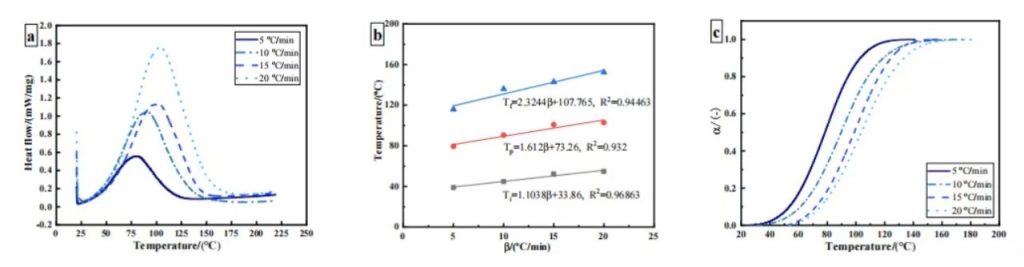
The figure shows the DSC results of the epoxy adhesive:(a) Dynamic DSC curves of the epoxy adhesive at different heating rates;(b) Characteristic curing temperatures;(c) Relationship between curing degree and temperature.
Characteristic parameters of the curing process at different heating rates

The curing reaction of epoxy resin follows a “slow–fast–slow” profile. As the heating rate increases, the temperature corresponding to the maximum curing reaction rate shifts to higher values, with the peak rising from 80 °C to 104 °C.
Due to an induction period, the initial curing rate of the system is slow. As the reaction proceeds, the exothermic heat further accelerates curing. In the later stage, the cross-linking density increases and the curing rate gradually slows down. The fastest reaction rate occurs at a curing degree of 40–60%. The results indicate that the epoxy adhesive follows an autocatalytic curing reaction mechanism.
Summary: Advantages of DSC
- Simple operation, requiring only milligram-level sample amounts
- Rapid testing (completed in dozens of minutes)
- Intuitive data with strong automated analysis capabilities
- Extensive applications across materials, pharmaceuticals, food, metals and more
Precautions
- Samples should not decompose (TG testing is recommended beforehand)
- Heating rate affects peak shape and requires standardization
- Crucible selection must match the material properties
DSC acts like a “thermal behavior microscope” for materials, allowing you to observe molecular-level changes. It truly is an indispensable “thermal analysis powerhouse” for R&D, quality control and failure analysis.